
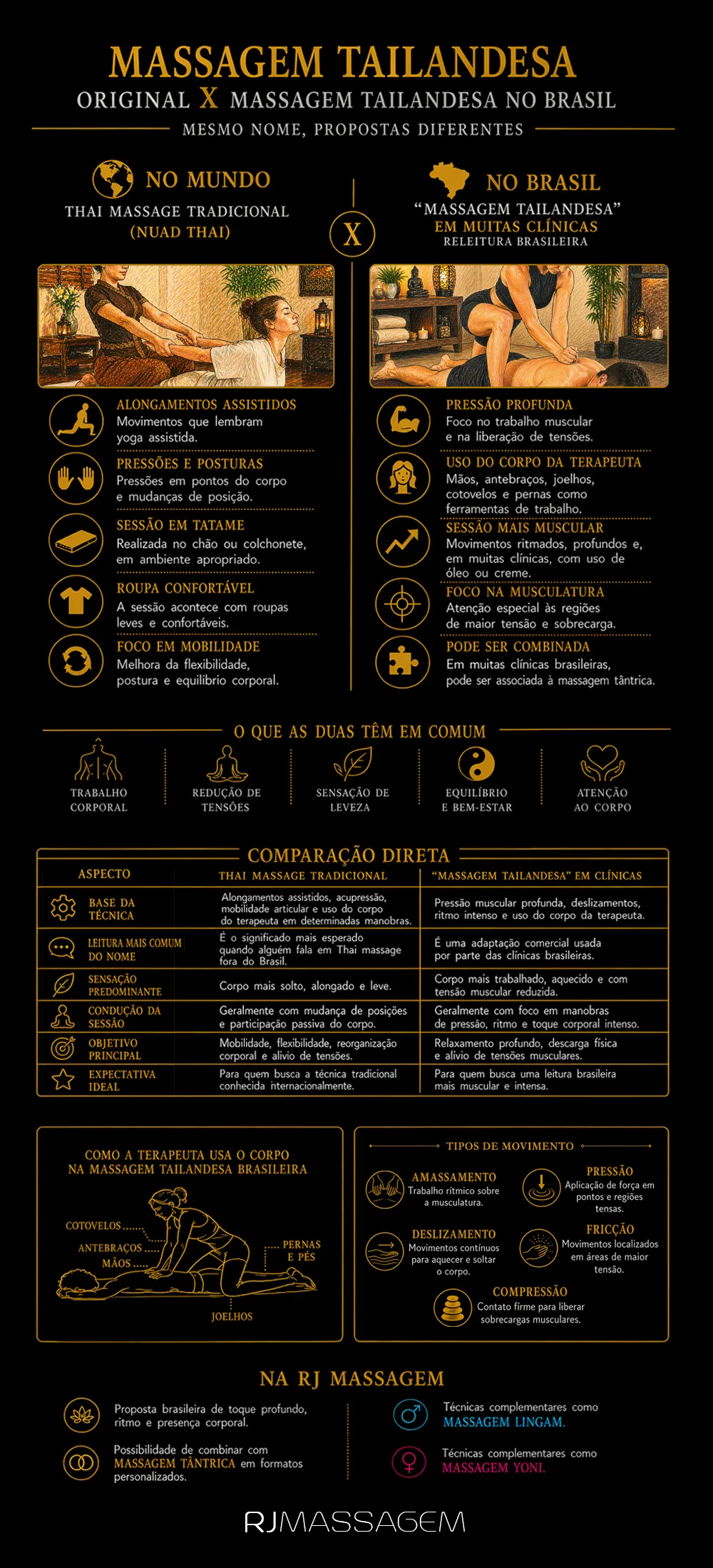
If you have ever looked into Thai massage, you have probably noticed a very common source of confusion: the same name is often used for very different experiences. In Brazil, especially in bodywork and tantric massage clinics, “Thai massage” usually refers to a local interpretation of the technique, with an emphasis on deep pressure, intense muscular work, and the use of different parts of the therapist’s body. Outside Brazil, however, Thai massage almost always refers to traditional Nuad Thai — an ancient practice recognized by UNESCO as an Intangible Cultural Heritage of Humanity, built around assisted stretching, rhythmic compression, and joint mobility.
That distinction matters more than it may seem when booking a session. It shapes the kind of touch involved, the overall feeling in the body afterward, and, above all, whether the experience will match what you are actually looking for.
What is the original Thai massage?
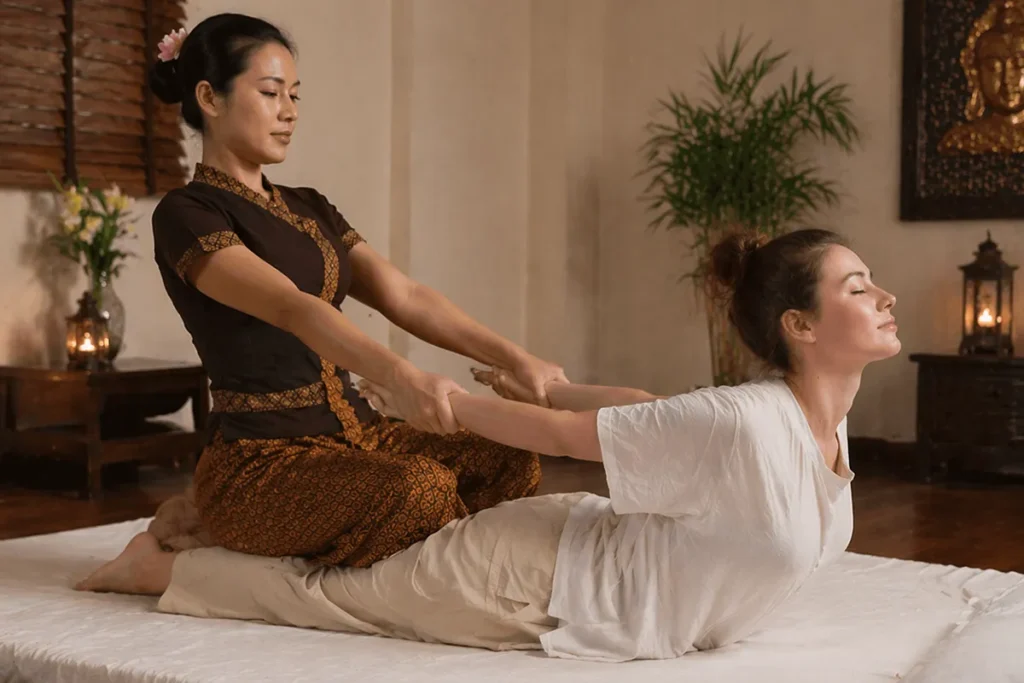
Traditional Thai massage, known as Nuad Thai, has been part of Thailand’s healing culture for centuries. Rather than focusing only on pressure over the muscles, it combines acupressure, gentle movement, and therapist-guided passive stretching. That is why many people describe it as a form of “assisted yoga.”
The session usually takes place on the floor, on a mat or padded surface, with the client wearing comfortable clothing. There is no oil and no continuous gliding strokes. The therapist works with the hands, thumbs, forearms, elbows, knees, and in some movements even the feet, applying pressure while guiding the body through openings, light twists, and changes of position. The main goal is not simply muscle relaxation, but also the release of deep tension, better mobility, and a broader sense of physical realignment.
What has Brazil come to call Thai massage?
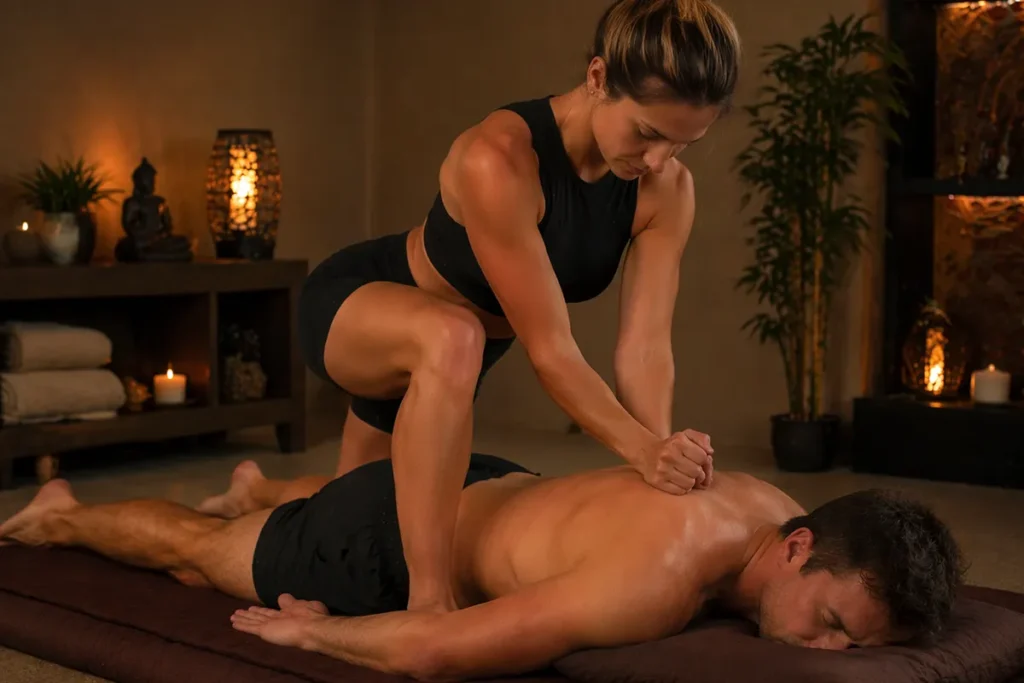
In Brazil, the term has taken on a different meaning across much of the market. In many clinics, “Thai massage” refers to a deep, rhythmic, and intense body massage aimed primarily at relieving muscular tension and creating a strong sense of physical release, often linked to tantric massage and, in many cases, to specific endings such as Lingam or Yoni.
In this Brazilian version, the therapist may also use forearms, elbows, knees, and other parts of the body to apply pressure and body weight. There are similarities with the traditional method in the use of these tools, but the intention is different. Here, the focus tends to be more on firm muscular work, rhythm, and intensity of touch than on a continuous sequence of assisted stretches.
In practice, the name may be the same and some of the tools may overlap, but the experience and the purpose of the session are quite different.
Why do so many people get confused?
Simply because the same name is used for two distinct approaches. Since both the traditional version and the Brazilian one may involve elbows, knees, and even feet, many people assume they are the same thing. Someone who has experienced Thai massage abroad will often expect a session centered on stretching, mobility, and posture work. Meanwhile, someone who only knows the Brazilian version may imagine that “real” Thai massage is a heavy muscular treatment with long gliding strokes from start to finish, which does not reflect what Nuad Thai means internationally.
So which one is better?
That depends on what you are looking for.
If your goal is a more traditional technique, with an emphasis on assisted stretching, mobility, and the feeling of a looser, more reorganized body, the original Nuad Thai is usually the better fit. On the other hand, if you prefer a session with firm touch, strong body presence, deep pressure, and immediate muscular relief, the Brazilian version will likely suit you better.
One is not inherently “better” than the other. What matters is understanding that they are not the same technique and choosing with the right expectation in mind.
How does this show up at RJ Massagem?
At RJ Massagem, we follow the Brazilian interpretation of the technique: a massage with deep touch, marked rhythm, and strong body presence, designed to relieve tension and work more deeply into the muscles.
If you want to understand the session more clearly, it is worth visiting the Thai massage page on the RJ Massagem website. There, we explain the proposal behind this treatment in more detail: it is muscular, more intense, and grounded in a Brazilian approach, even though it may use some elements that also exist in traditional Nuad Thai.
It is also common for us to combine this approach with other in-house techniques. When paired with tantric massage, for example, the session may include specific final stages such as Lingam for men or Yoni for women.
If you would like to know more about the experience at RJ Massagem, the session description on our website is a great place to start.
Final Thoughts
At the end of the day, original Thai massage and what is called Thai massage in Brazil are not synonyms. They may share some tools and points of contact, but the logic of the session is different. One is rooted in traditional Nuad Thai, with its emphasis on stretching, mobility, and acupressure. The other is a Brazilian adaptation, more centered on deep pressure and muscular release.
Understanding that difference helps you book with more clarity, choose the kind of touch that makes sense for you in that moment, and get far more out of the session in a way that feels informed and satisfying.
Editorial note: In Brazil, terminology may vary from one clinic to another. For that reason, it is always worth checking the session description before booking.
Frequently Asked Questions
O que muda mais entre a massagem tailandesa brasileira e a original?
A principal diferença está na condução da sessão. A original tende a trabalhar mais alongamentos e mobilidade; a brasileira costuma focar mais em pressão muscular profunda e intensidade corporal.
Quem já fez Thai massage fora do Brasil estranha a versão brasileira?
Pode estranhar, sim. Quem conhece a original, normalmente espera uma sessão com alongamentos assistidos, mudanças de posição e trabalho postural, enquanto a versão brasileira costuma ser mais muscular e focada em pressão forte.
A massagem tailandesa tradicional ajuda na flexibilidade?
Sim. Como a técnica trabalha alongamentos assistidos e mobilidade, ela costuma ser associada a ganho de flexibilidade e à sensação de um corpo mais solto.
A massagem tailandesa brasileira tem alongamentos como a original?
Pode até ter alguns alongamentos em certos momentos, mas nesse caso eles não são a parte fundamental da sessão como no Nuad Thai tradicional.
A massagem tailandesa original inclui Lingam ou Yoni?
Não. O Nuad Thai tradicional não inclui Lingam nem Yoni. Essas técnicas aparecem em outros tipos de atendimento e, no Brasil, costumam estar associadas à massagem tântrica.
Now that you know the difference, take the next step
Explore Thai massage at RJ Massagem and choose a session that feels more aligned with your body and your goal.
